| 15th Anniversary  |  January 15-31, 2027 |  Exchanging Ideas  |  Inspiring Discussion  |  Igniting Change

| 15th Anniversary  |  January 15-31, 2027 |  Exchanging Ideas  |  Inspiring Discussion  |  Igniting Change

| 15th Anniversary  |  January 15-31, 2027 |  Exchanging Ideas  |  Inspiring Discussion  |  Igniting Change

| 15th Anniversary  |  January 15-31, 2027 |  Exchanging Ideas  |  Inspiring Discussion  |  Igniting Change

Category

NEWS

DreamWeek plans to celebrate MLK long before his holiday / San Antonio Express News 2015

By NEWS

By Elaine Ayala: January 4, 2015

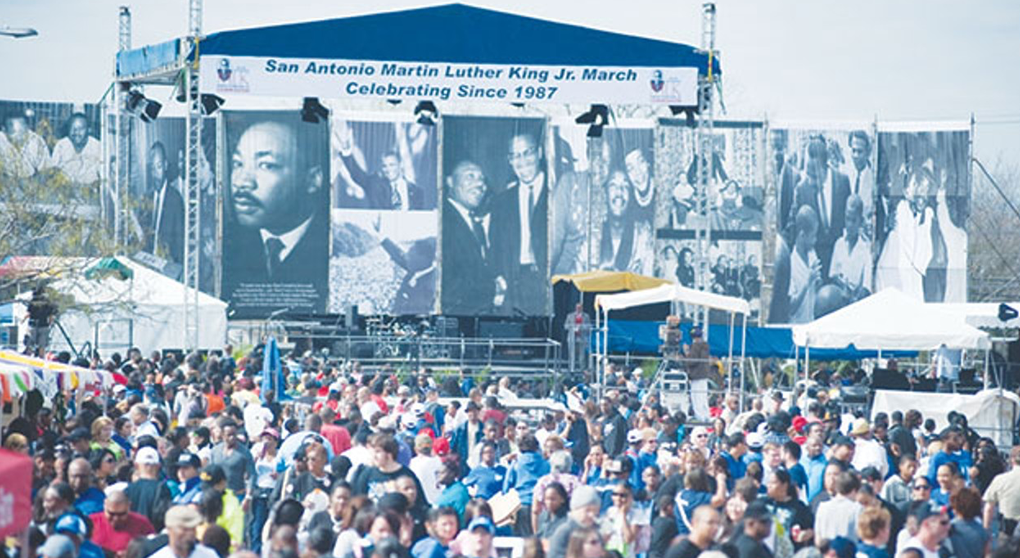
Shokare Nakpodia has posed the question to himself and many others: Why does San Antonio, a city with such a small African-American community, host the nation’s largest Martin Luther King Jr. march, which this year is expected to gather more than 100,000 on Jan. 19 on the city’s East Side?

Many have tried to answer that intriguing question over the years, recalling that black pastors in the 1960s worked diligently to promote the Rev. King’s call for nonviolent protest, fearing what riots, exploding all over the country, would do to race relations in San Antonio and their congregations, in particular.

Others have pointed to King’s major contributions as the reason for the massive march, noting San Antonio’s ability to quell race violence while other U.S. cities could not. But the question has persisted, especially since San Antonians of all creeds, classes and colors magically get together on MLK Day in one of the poorest, highest-crime areas of the city yet are essentially segregated the rest of the year.

“No one could tell me how the march came about,” says Nakpodia, a Nigerian who spent a lot of time in London and New York before making San Antonio home. He says the Alamo City somehow managed to resolve conflicts with far less drama than others did.

“There’s something underneath all this that San Antonio has that no one else does,” he says.

Whatever that is, it encouraged Nakpodia’s dream of DreamWeek, which begins its third year Friday. “DreamWeek was created to celebrate and recognize San Antonio for creating the largest march in the country.”

For 12 days this month, Nakpodia will lead a large coalition of groups and individuals that have signed on to expand the celebration of a federal, state and local MLK holiday from one day to 12. From Jan. 9-20, about 70 events marking King’s dream of equality, diversity and tolerance will come together in sites throughout the city.

DreamWeek has planned no single transformative event. But the underlying goal of every mixer, discussion, film screening or gala under its umbrella is to create a “cerebral SXSW,” Nakpodia says, referring to the nationally recognized music and film festival that invades Austin each spring.

People like Nakpodia dream big.

Festivities begin with a breakfast ceremony at the Briscoe Museum this Friday. It’s one of seven events that day that include the San Antonio Museum of Art’s Dream Wall event, Dream pARTy mixer and sessions on making of Native American dream catchers; the San Antonio Public Library’s kickoff at its Carver Branch; and the San Antonio Ivy Foundation’s evening with scholar, author and activist Cornel West.

Nakpodia is especially looking forward to a Jan. 15 townhall titled “The Police, Our Community and the Future” at Second Baptist Church. Bexar County District Attorney Nicholas “Nico” LaHood will speak. Nakpodia says the discussion will include police, city officials, community leaders, gang members and residents and will address racial profiling, police abuse, police internal affairs procedures and the use of excessive force.

Rather than have such discussions during conflict, Nakpodia says, “it’s best to have an annual exchange where we discuss these things.”

Former Mayor Julián Castro played a role in creating DreamWeek when he challenged several agencies to come up with new ways to brand San Antonio beyond the Alamo and River Walk and tell a national audience about the city’s MLK march. Nakpodia’s The Mighty Group was among those agencies.

2014 was the year of global protests that Nakpodia says began in his home country after Boko Haram gunmen abducted more than 200 girls. The violence prompted a hashtag #BringBackOurGirls that became known the world over. More violence lead to more hashtags, including #BlackLivesMatter, #Ferguson, #MichaelBrown, #EricGarner, #Iguala and #Ayotzinapa.

Perhaps San Antonio can start the new year with a fresh set of more hopeful hashtags, including #MLK, #DreamWeek, #equality, #diversity and #tolerance.

DreamWeek gives us hope before and beyond MLK Day, especially when Nakpodia says the best form of protest is at the polls. Tuesday’s election gives you another chance to be heard. #Vote.

eayala@express-news.net

Twitter: @ElaineAyala

DreamWeek 2015 to Promote Tolerance and Equality / Rivard Report

By NEWS

By Jackie Calvert: January 3, 2015

San Antonio’s third annual DreamWeek summit kicks off Friday, Jan. 9, and promises to be filled with more than 70 events in 12 days, including speaking engagements, mixers, workshops, and celebrations to garner discussions on issues happening in our city and across the globe. This year the summit will feature themes including city, health, youth, environment, technology, education, arts, spirit, justice, business, sports, and food.

DreamWeek began with Mayor Julián Castro’s challenge to several ad agencies to come up with ways to expand the San Antonio brand outside of the River Walk and the Alamo. The themes featured in DreamWeek are chosen to promote and broaden the appeal of San Antonio. The city has one of the largest MLK marches in the United States, so it’s fitting that DreamWeek takes place 12 days before Martin Luther King, Jr. Day.

Shokare Nakpodia, creative director of The Mighty Group, was up for the challenge.

“I realized the (MLK) march was getting bigger, and I was very intrigued that we had an 8% African-American population, but the march was still attracting over 150,000 people – mostly African American, yes, but there were still a lot of outside supporters,” he said.

Nakpodia, who is president of DreamVoice LLC, which produces DreamWeek, began investigating how San Antonio had the largest march in the nation.

“I knew it was more than logistics and goodwill inherent in the community. The best answer I received was from Tom Frost: ‘For a large city, we tend to resolve conflict with very little drama.’”

With that answer, Nakpodia’s vision was realized. The plan was to get at least 100 organizations and nonprofits to host an event to touch on various social issues before they become areas of conflict. The goal is to have sophisticated, well-defined, and well-thought-through debates instead of polarizing arguments where insults and tempers flare.

“We want to promote voices of tolerance, diversity, and equality, but not necessarily taking a side. DreamWeek is a call to several organizations that we promote. We have about 40 different partners who model what we are trying to pursue,” Nakpodia said. “This promises to be the largest DreamWeek summit to date … which is a measure of the community’s support for the events and activities being promoted. There has never been a better time in this nation to reflect and discuss the many areas of conflict due to race, ethnicity, religion, gender, and class.

“We may not find all of the answers but our goal is to provide an environment that allows for a healthy exchange of ideas and dialogue on these issues,” he said.

San Antonio’s 2014 MLK Interfaith Service / Texas Public Radio

By NEWS

By Texas Public Radio : January 19, 2014

The 27th annual Rev. Martin Luther King, Jr. citywide Interfaith Worship Service was held on Sunday, January 19, 2014, at Antioch Baptist Church, and featured guest speaker Rev. Carl Rohlfs. He is District Superintendent of the San Antonio District of the United Methodist Church.

The event was part of Dreamweek, a 12-day summit “designed to promote an exchange of ideas on universal issues facing our multi-cultural communities.”

MLK-Commission

Source

Freedom Riders Inspire Ahead of Martin Luther King Jr. March / MySA

By NEWS

By Maria Luisa Cesar : January 18, 2014

SAN ANTONIO — Hungry to hear first-hand accounts of what it was like to be a civil rights activist fighting to end segregation in the Deep South in 1961, community members packed into the San Antonio Museum of Art on Saturday for a screening of the PBS documentary film “Freedom Riders.”

The event was capped off with a panel discussion featuring a handful of the groups’ original members — whose stark recollections of their abuse, courage and victories drew a standing ovation from the crowd of about 200 people.

“We’ve been concerned that our young people aren’t as involved with their rights,” said Julia Aaron Humbles, a Freedom Rider who was one of the first to be arrested.

She told the group that history is doomed to repeat itself if people don’t learn about their past and take action.

“There’s still a fight to be fought, but we’re too old to fight it,” she told the crowd, making them laugh.

Freedom Riders answer questions after a screening of the film "Freedom Riders" at the San Antonio Museum of Art on Saturday, Jan., 18, 2014. Freedom Riders were groups of African-American and white people who rode buses together through the deep South in 1961 in the hope of advancing desegregation. The screening and discussion were part of DreamWeek, a twelve-day summit to promote ideas on diversity, tolerance and equality. Photo by San Antonio Express News

Freedom Riders answer questions after a screening of the film “Freedom Riders” at the San Antonio Museum of Art on Saturday, Jan., 18, 2014. Freedom Riders were groups of African-American and white people who rode buses together through the deep South in 1961 in the hope of advancing desegregation. The screening and discussion were part of DreamWeek, a twelve-day summit to promote ideas on diversity, tolerance and equality.
Photo by San Antonio Express News

Freedom Riders brought attention to the persistent racial inequality in the South by filling buses with white and African-American activists and riding them into towns where segregation continued. Audience members asked the group of four what it was like to tell their parents they had decided to participate in the Freedom Rides and whether abuse continued in prison. Patricia Dilworth, a San Antonio resident who was 18 when she decided to take part in the demonstrations, told the crowd that abuse at the hands of prison guards included cramped cells, being fed cornbread with a can of pepper tucked inside, “nasty comments” and only being allowed one shower a week.

When asked if they understood how their actions would shape history, Dilworth laughed.

“I was 18,” she said. “I didn’t know anything.”

Hezekiah Watkins, 13 when he became a Freedom Rider, speaks at the San Antonio Museum of Art. Photo by Billy Calzada/San Antonio Express News

Hezekiah Watkins, 13 when he became a Freedom Rider, speaks at the San Antonio Museum of Art.
Photo by Billy Calzada/San Antonio Express News

Several audience members took the opportunity to personally thank the group, which included MacArthur Cotton and Hezekiah Watkins, one of the youngest Freedom Riders.

Lesa Bailey said she was brought to tears by the documentary and deeply moved by the panel discussion.

“I think now about what I can do better as a person in my life to honor their struggles to make everybody equal,” she said after the discussion.

Part of Dream Week events held throughout the city in honor of the work done by Dr. Martin Luther King Jr., the panel was orchestrated by the Dr. J.R. Bowie III Scholarship Foundation and sponsored by the San Antonio Public Library Foundation and the San Antonio Public Library.

The Martin Luther King Jr. March is scheduled for 10 a.m. Monday at the MLK Academy and is considered one of the largest in the country.

Source

mcesar@express-news.net

Twitter: @mlcesar

DreamWeek Seeks to Promote MLK Jr.’s Legacy of Diversity, Equality / SA Current

By NEWS

By Mary Tuma : January 15, 2014

SA Current - Cover

As Martin Luther King Jr. Day approaches, San Antonio—home to the largest MLK Day March in the nation—will be buzzing with events aimed at modernizing the late civil rights leader’s teachings. The 12-day summit dubbed “DreamWeek” features more than 60 speakers, screenings, mixers, youth events, workshops and parties centered on preserving the legacy of King. Presented by the City’s MLK March Commission and DreamVoice, a non-profit offshoot of local media company The Mighty Group, the conference is billed as a means of promoting “an exchange of ideas on universal issues facing our multi-cultural communities.”

Still in its infancy, this is DreamWeek’s second attempt, and if the goals of The Mighty Group’s president Shokare Nakpodia—or “Sho” as he’s called—go according to plan, it will be a San Antonio staple event for decades to come. But let’s backtrack a bit: How did the idea come to fruition and what are SAers supposed to gain from going?

SA Current - Sho

Shokare Nakpodia, DreamVoice San Antonio President

A native of Nigeria, Nakpodia left Africa in his teens to study in London before heading to New York for an education in the visual arts. He eventually settled in San Antonio to form his local marketing group, which specializes in messages laced with community empowerment. During a meeting called by Mayor Castro a few years ago, Nakpodia and eight others representing various groups around town were tasked with expanding the image of SA beyond just the River Walk or the Alamo.

While he was overlooked for the MLK March assignment, instead assigned to focus on the military, Nakpodia’s interest was piqued. Still ruminating on ways to further promote the leader’s legacy, a year later his non-profit won a contract to beautify MLK March Day graphics—and that’s when Nakpodia got the ball rolling.

“I thought, how can we advance the voice by presenting all the different parties and issues and get everyone to come together and resolve these conflicts?” Nakpodia tells the Current at the Mighty Group headquarters on East Commerce Street during an interview a day shy of the summit’s kick-off event.

Nakpodia elaborates: “I wanted to host an environment where we can create healthy debate. Why don’t we move past the civil rights discussion and also start talking about immigration issues, women’s issues, gay and lesbian rights issues?”

The DreamWeek lineup includes speaker Dr. Michael Eric Dyson, author of April 4, 1968: Martin Luther King Jr.’s Death and How it Changed America, a screening of Freedom Riders and subsequent discussion with four of the original participants, an MLK oratorical contest and a stream of events from thought-provoking to whimsical.

The co-host considers last year’s inaugural DreamWeek a success. While the group tapped organizations (local universities, restaurants and art museums) to participate during its first go-around, preparing for the 2014 event was noticeably more fluid: This time, organizations solicited them. If the trend continues, Nakpodia hopes to multiply the number of events and, eventually, take DreamWeek national—and even global one day, he muses aloud.

The long-term ambition is getting big-ticket speakers in the mix—leading theorists, academics and personalities—associated with resolution and, as Nakpodia puts it, “the face of America’s tomorrow.” (A couple of names on his speaker wish list: Cornel West and Desmond Tutu.)

If the summit gains enough momentum and expands to meet Nakpodia’s vision, one aspect will certainly remain the same: Each event must encourage tolerance, equality and diversity.

“Diversity is not how many people of different cultures are existing in one place, diversity is how many people of different cultures have access to other people’s cultures and celebrate it,” says Nakpodia.

Amid DreamWeek’s feel-good call for equality and tolerance, local African-American rights leaders remind us there’s still a long and rugged road ahead for black progress.

SA educator and writer Fred Williams argues one of the major problems impeding black progress comes from within communities and from the generational psychological damage inflicted upon black youth. “These kids are very pessimistic about life; they are seeing they don’t have options so they end up in prison or worse. How do we change that around? That’s our big dilemma,” he says.

The San Antonio College professor and author of African American-based literature feels particularly nostalgic about MLK Day. While working for former Indiana Democrat Sen. Birch Bayh years ago, Williams helped coordinate a hearing to promote the federal holiday, initiated after a request made by Coretta Scott King (widow of the late leader) to get legislation introduced on the Senate side. “I feel really close to the holiday,” says Williams.

“MLK changed the whole face of America. Just 30 years ago, I couldn’t walk into a classroom and teach. Today my students don’t think, ‘here’s a black instructor’—they ask ‘how hard is this teacher going to be?’” he says.

“The civil rights problems today are somewhat different,” Williams continues. “Racism is still alive but it’s controlled. And if there is some semblance of it, there’s recourse.”

San Antonio NAACP President Oliver Hill contends institutional racism is still pervasive and threatening. Hill points to recent attempts by state legislatures to restrict minority voting, such as the infamous voter ID law—enacted here in Texas—as examples of systemic oppression. (The law, which prohibits certain forms of identification at the voting booth, disproportionately impacts minorities—the Department of Justice and federal courts have found it discriminatory and unconstitutional.)

“The more things change, the more they remain the same,” says Hill. Comparing it to a contemporary version of a poll tax, Hill says voter ID laws fall “under the guise of voter integrity,” but are truly meant to prevent minorities, especially African-Americans, from voting.

Locally, Hill hears several complaints of police brutality, intimidation and school bullying based on race. He also says there’s been a mass exodus of educated African-Americans from San Antonio, fleeing to find better job opportunities. “Our young folk that are going to college don’t come back because there is no reason to return—they can’t get hired. We need more homegrown African-Americans in employment and leadership positions,” says Hill.

SA Current - March

The MLK Day March in SA attracts aproximately 100,000 participants

While on his search to answer why SA holds the nation’s largest MLK March, attracting an estimated 100,000 people, Nakpodia discovered the city’s reputation for peaceful resolution—perhaps signaling hope that the problems for minority communities may not vanish any time soon but that, at the least, thoughtful dialogue on progress and reconciling differences may emerge—the very point of the MLK Jr.-inspired conference.

“I learned that we tend to resolve our conflicts with less drama and more tolerance than most other cities of our size,” Nakpodia said.

DreamWeek runs from January 10-21; a full schedule of events can be found at dreamweek.org.

Source

San Antonio kicks off DreamWeek 2014 citywide celebration / San Antonio Business Journal

By NEWS

By James Aldridge : January 14, 2014

San Antonio has launched DreamWeek San Antonio 2014, a 12-day citywide summit that is designed to advance Dr. Martin Luther King’s dream of a society that embraces cultural diversity, tolerance and equality.

DreamWeek began Friday, Jan. 10 and will last through Tuesday, Jan. 21. The San Antonio Museum of Art, McNay Art Museum, Blue Star Contemporary, San Antonio Children’s Museum, Carver Community Culture Center, Artpace, the University of Texas at San Antonio, Trinity University and St. Philip’s College are hosting art exhibits, mixers, readings, lectures and film screenings in support of the summit.

The summit will revolve around the themes of city, health, youth, environment, technology, education, arts, spirit, justice, business, sports and cuisine.

Visit DreamWeek.org for activities and the full slate of events throughout the week.

The City of San Antonio’s Martin Luther King Day Annual March will take place on Monday, Jan. 20.

source

5 Things You Have to Do This Week – The Loving Story / SA Current

By NEWS

By Bryan Rindfuss : January 13, 2014

Tue 1/14 Created Equal Film: The Loving Story

THE LOVING STORY Trailer from Icarus Films on Vimeo.

In 1958, a white man named Richard Loving and his half-black, half-Native American fiancée Mildred Jeter traveled to Washington D.C. to get married. Weeks later in the dark of night, the newlyweds were arrested at home in Virginia for violating an anti-miscegenation statute. To avoid a one-year prison sentence, the couple agreed to be banished from Virginia for 25 years. For the next nine years, the Lovings fought the ruling, which resulted in a landmark Supreme Court decision in 1967. Through a combination of archival 16mm footage, documentary photographs shot by Grey Villet for LIFE magazine, and recent interviews, Nancy Buirski’s 2011 documentary The Loving Story celebrates these often-overlooked civil rights heroes. SAMA screens the film as part of its DreamWeek programming. Free, 6:30pm Tue, San Antonio Museum of Art, 200 W Jones, (210) 978-8100, samuseum.org.

Source

Students try their hand at MLK-style oration / MySA

By NEWS
By David Hendricks : January 11, 2014

SAN ANTONIO — Martin Luther King Jr. would not have risen to become a civil rights icon without his stirring oratorical skills.

With that premise, organizers affiliated with the 12-day DreamWeek that observes King’s birthday holiday launched the first-ever oratorical contest for middle and high school students, held Saturday morning at Second Baptist Church.

Six students competed, and four winners split $900 in cash prizes during the event, organized by a committee headed by Karl Nicolas and sponsored by the city’s Martin Luther King Jr. Commission and the National Pan-Hellenic Council.

Each student delivered, before a panel of judges, a four- to six-minute speech addressing the topic: “Why Dr. Martin Luther King Jr. believed education excellence affects one’s future freedoms.”

Contest rules prohibited the students from identifying themselves or their schools during their speeches. Also prohibited were photography and applause. In place of applause, the audience of more than 50 people, mainly participants’ family and friends, responded with silent fist pumps.

“Education should liberate and free our minds,” one student said. “Wisdom is the key,” she added. “Wisdom is the ability to reason.”

Several students addressed high school dropout rates in San Antonio and elsewhere and the results in society.

“Even today, African-Americans are incarcerated at six times the rates of whites,” one student said. He then cited the 2012 case of the slaying of Florida youth Trayvon Martin, whose acquitted accused shooter’s “questionable character is headlines in the news. … Education is a civil right. … This fight for freedom is not over.”

Several speakers also paid tribute to King and his legacy. They cited the facts that King had completed high school at age 15 and received a doctorate degree from Boston University.

One student called King’s education a blueprint for today’s students.

“Because of what (King) did, I can stand before you, educated with a sharp mind.”

“I have concern for my generation,” added another student who cited obsessions with mobile technology. “A good education can take you further than temporary gratification.”

One student credited her family for inspiration. “My mom always said, ‘Do your best,’ with Christmas speeches, Easter speeches, baseball or softball. She said, ‘That’s good, but I know you can do better.’ My grandfather always said, ‘Think, think, think. … Think intensely and critically.’ ”

Another speaker observed, “Education takes many forms, in the classroom and life experiences.” He then described experiences in Turkey, where the population is 99 percent Muslim, he said. “They are not terrorists. They are nice people, like you and me. I quickly realized their religion had nothing to do with terrorism.”

The students were judged on articulation, gestures, purpose, appearance and other factors.

The judges were Spring Meadows Elementary School Principal Christina Clark, U.S. Army North Col. Lisa Wilson, Ameriprise Financial Services Inc. financial advisor J. Maurice Gibbs and Tracy James, a Fort Sam Houston instructional systems specialist.

Organizer Nicholas credited lawyer Daryl Harris with the idea to start the event. Eventually, Bishop David Copeland of New Creation Christian Fellowship and chairman of the city Martin Luther King Jr. Commission added his support to the oratorical contest.

Copeland encouraged the students before they spoke. “What you say, how you say it and with whom you say it … can determine paths of achievement in your lives,” Copeland said. “You can make a difference.”

dhendricks@express-news.net

Source

Six Must-Attend Events: January 10-12 / Texas Monthly

By NEWS

By Michael Hoinski : Jan 10, 2014

San Antonio – Dream On
In San Antonio, proponents of peace and equality dream big. Dream Week, a 12-day celebration inspired by the Rev. Dr. Martin Luther King Jr. and his “I Have a Dream” speech, is an ambitious homage. The anchor of this citywide event is a march on the final day, a longtime annual event drawing around 100,000 to San Antonio’s east side — and one of the largest such marches in the country. Leading up to that most stalwart of traditions are a number of programs centered on Dr. King, including an oratorical contest for students; the City Year M.L.K. Day of Service; and a commemorative lecture series, with Dr. Julianne Malveaux, whom the race-relations expert Cornel West called “the most iconoclastic public intellectual in the country.” Tying it all back to San Antonio is the 1005 Faces Mixer, highlighting the photographer Sarah Brooke Lyons’s 1,005 pictures of San Antonians.

Various locations, Jan. 10-21, dreamweek.org.

Source